Ginger milk tea has crossed from an everyday cafe and street-stall staple into a formal ready-to-drink export category, and the transition has pulled the product into a compliance conversation that reaches far beyond flavor. Importers and distributors across the Americas, Europe, Asia, the Middle East, Africa and Oceania
now assess a new beverage through its documentation stack before they assess its taste. For manufacturers operating at scale, the lesson from recent regulatory and advertising developments across the beverage sector is straightforward: formulation discipline, labeling accuracy and claim restraint have become competitive assets. Vietnamese OEM and ODM specialists such as RITA Food & Drink Co., Ltd have spent two decades building exactly that capability, supplying branded and private-label beverages to buyers in more than 200 countries and territories.
Key Takeaways
- Global demand for ready-to-drink ginger milk tea is expanding, but market access increasingly depends on a full certification stack rather than flavor alone.
- Regulators and advertising watchdogs are tightening scrutiny of beverage claims, making restrained, substantiated language a commercial necessity.
- Aluminum can packaging continues to win preference in export channels for its recyclability and durability across long shipping routes.
- The RITA Brand Premium Ginger Milk Tea Drink 325ml Can carries a 24-month shelf life and manufacturing capacity of 600 twenty-foot containers per month.
- Private-label ginger milk tea programs let buyers tailor sweetness, ginger intensity and can design while staying inside certified production processes.
Regulatory Pressure Is Reshaping the Global Ginger Milk Tea Trade
Across every major beverage market, the cost of a compliance failure now rises faster than the cost of compliance itself.
The warning signs are visible well outside the tea category. The UK advertising watchdog recently reprimanded meal-replacement brand Huel over health-related claims, a reminder that regulators watch claim language as closely in beverages as in any other food category. Established producers are adapting too. Danone has appealed a block on the expansion of Harrogate Spring Water while committing investment to what it describes as a benchmark site for Volvic, and Royal Swinkels has publicly argued that the non-alcoholic drinks space offers room for many entrants provided formats and claims stay disciplined. The pattern is consistent across the sector: expansion continues, but only inside clearly defined regulatory lanes.
For a product such as ginger milk tea, the practical question is not whether a market exists. It is what evidence a buyer needs before a listing conversation can begin.
The Certification Stack That Clears Market Access
For export-oriented ginger milk tea, the certification portfolio is the first commercial filter.
RITA manufactures its premium ginger milk tea can under a documentation set that covers the requirements most frequently raised in import audits. The company holds BRC and FSSC 22000 certification for food safety management, Halal certification under both Jakim and HCA-GCC schemes for markets where religious dietary standards govern retail access, Kosher certification for specialist retail and private-label channels, plus ISO, GMP and HACCP frameworks and SMETA ethical-audit alignment. Each credential removes a different barrier rather than a single one, which is why the full stack matters more than any individual certificate on its own.
| Certification |
What It Signals to Buyers |
Where Buyers Raise It Most |
| BRC |
Retail-ready food safety management audited to a recognised global standard |
European and global retail chains |
| FSSC 22000 |
Full food safety system certification with traceability discipline |
Multi-market importers and distributors |
| Halal (Jakim / HCA-GCC) |
Religious dietary compliance under Sunni-aligned and GCC schemes |
Middle East and Muslim-majority markets |
| Kosher |
A separate compliance pathway for kosher-certified retail programmes |
Specialist retail and private label |
| ISO / GMP / HACCP |
Consistent process control, hygiene documentation and monitoring records |
General export due diligence reviews |
| SMETA |
Ethical supply-chain audit alignment across labour standards |
Brand and distributor ESG screening |
Source: RITA Food & Drink Co., Ltd certification portfolio.
Practical buyers rarely stop at the certificate name. They ask who audited the site, when the audit was carried out, which product scopes are included and whether the destination market recognises the scheme. A can that appears under a BRC-certified scope with FSSC 22000 food safety management behind it clears that second round of questions faster than a product relying on a single domestic approval.
Claim Language and the New Advertising Test
Marketing copy, not just production records, now sits under regulatory review in many destinations.
The Huel case illustrates how quickly claim wording can attract enforcement attention even in a well-established category. For a ready-to-drink ginger milk tea, the safer route keeps the public narrative anchored in sensory description: the roasted depth of the black tea base, the warmth of the ginger character, the creamy texture of the milk component. Tasting notes travel well across markets; therapeutic promises travel badly. RITA positions the product squarely in the former camp, which also makes its marketing materials easier for importers to adapt to local advertising rules without rewriting the story.

The RITA Brand Premium Ginger Milk Tea Drink 325ml Can was developed to be simple to verify as well as simple to enjoy.
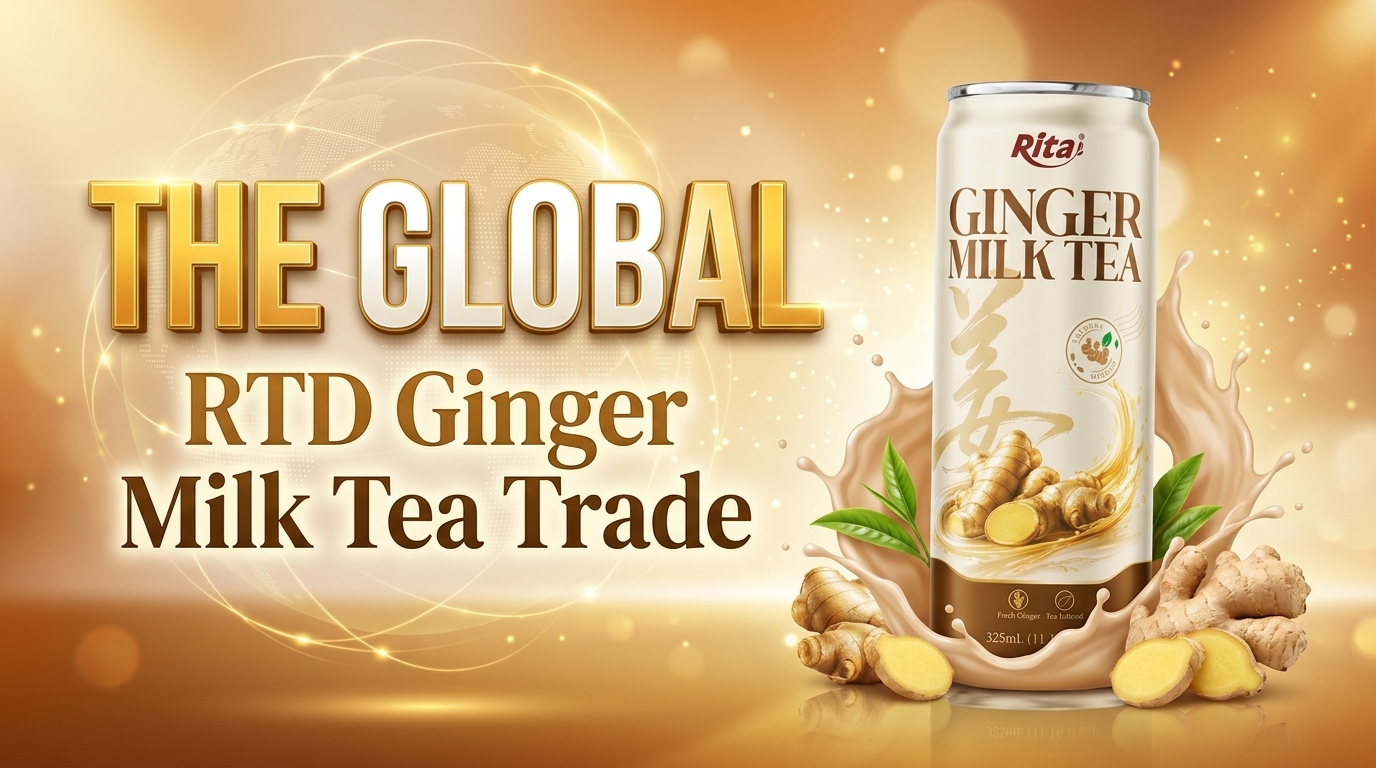
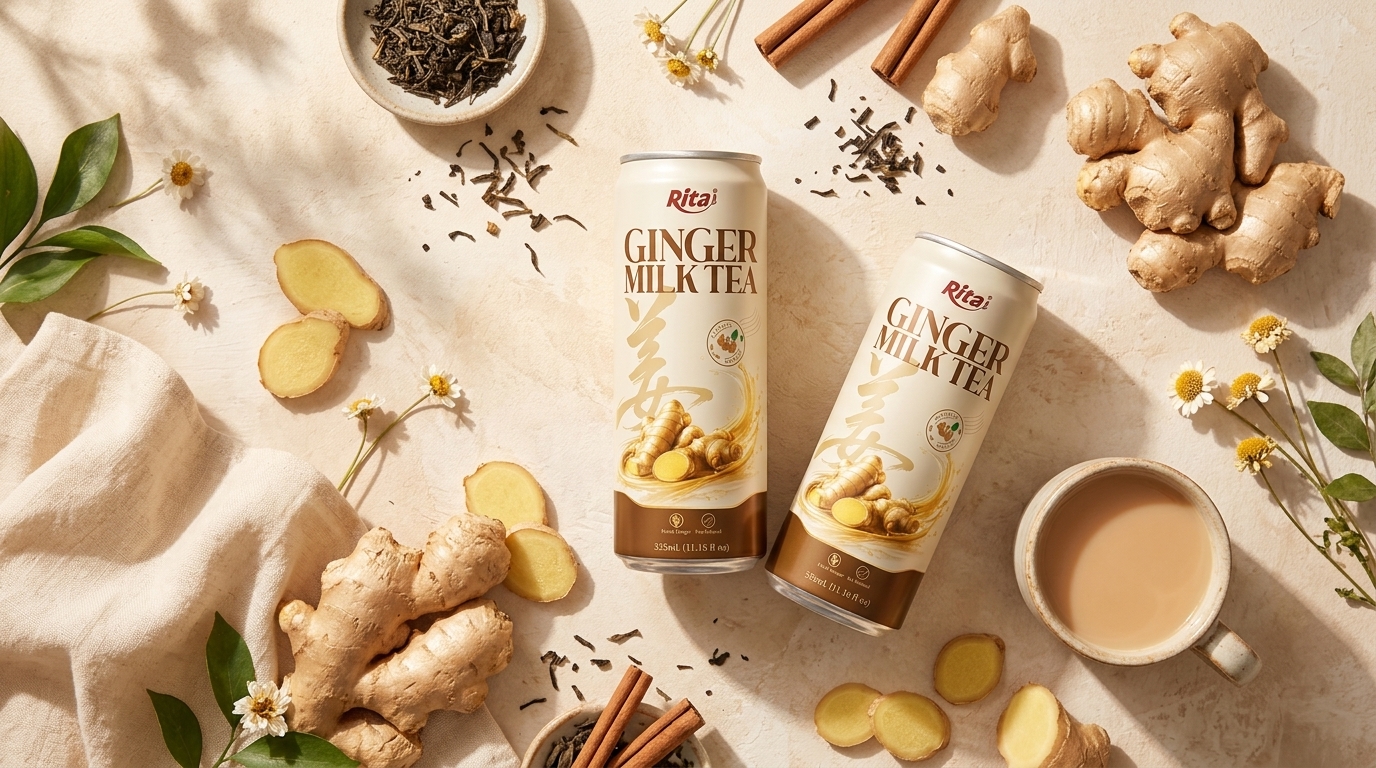
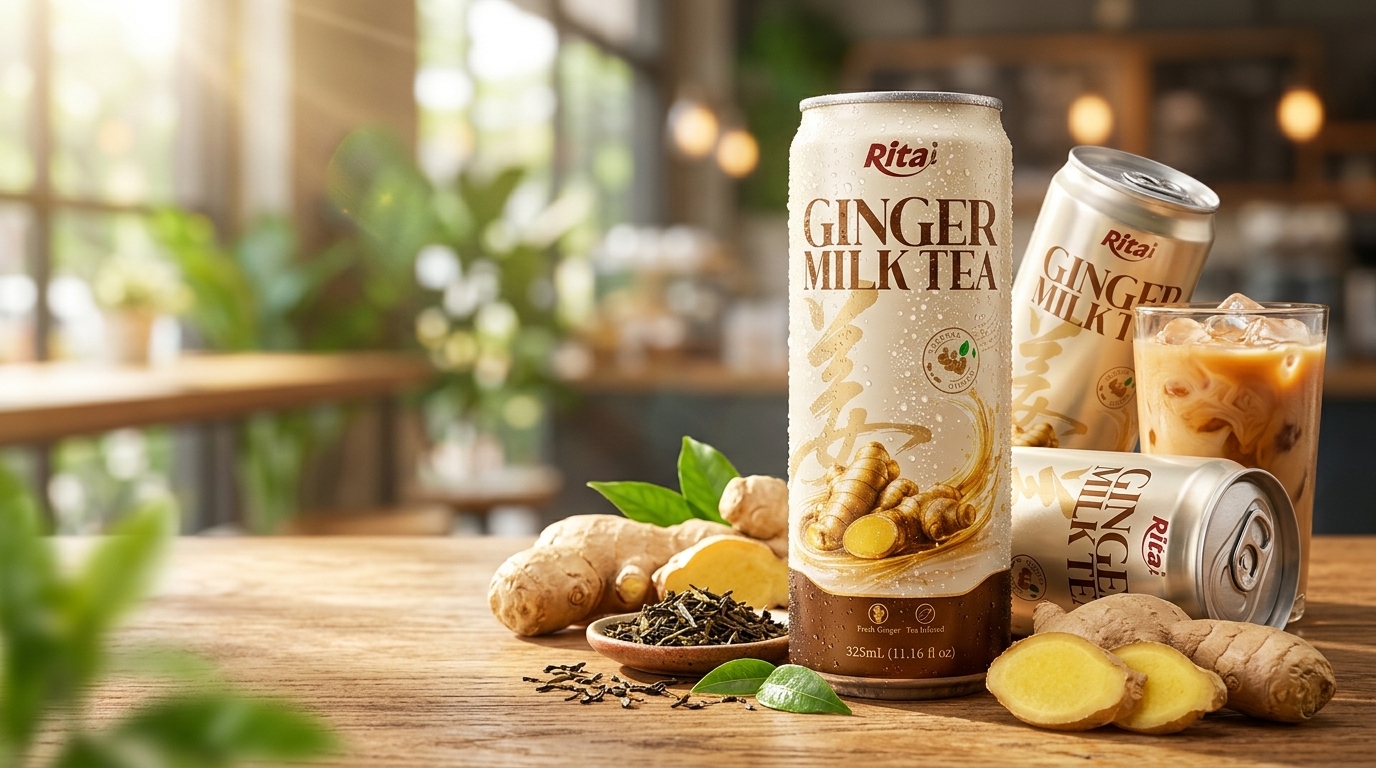
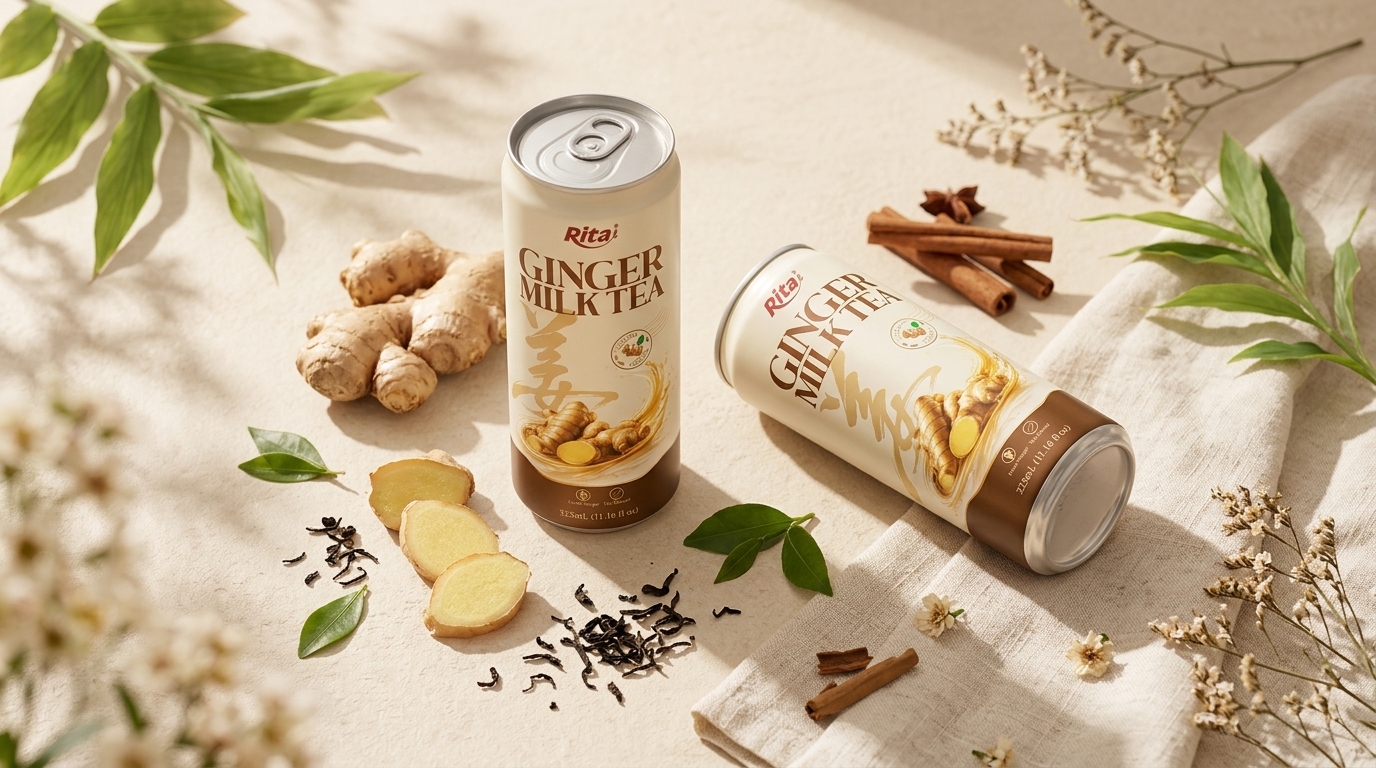
Three core ingredients carry the profile. Premium black tea leaves provide a deep, roasted aroma and a clean tea backbone; natural ginger essence adds a subtle yet noticeable warmth; and a silky milk blend softens the tea intensity and delivers a comforting mouthfeel. On the nutrition panel, each 100 ml serving contains 38 kcal, 20 mg sodium and 23 mg vitamin C, figures that keep the nutrition declaration compact and straightforward to check against national labeling rules. The presentation follows the same logic: a cream background with brown and gold accents, large GINGER MILK TEA lettering, a gold stylized character for ginger, a circular Natural Ginger badge and a dark brown base band carrying icons and product information.
That visual discipline matters more than it might appear. Retail buyers in Europe, the Middle East and North America increasingly audit label panels for legibility, ingredient listing order and claim wording before a product even reaches shelf discussion. A can that reads clearly on a first pass shortens the review cycle and reduces the number of revision rounds an importer has to fund.
Aluminum Can Packaging and the Sustainability Angle
Export packaging choices are now judged against environmental standards as well as logistics performance.
The 325ml slim aluminum can was selected for both reasons. It is lightweight, which reduces freight burden over long shipping routes, and fully recyclable, which aligns with packaging expectations now common in North American, European and Asian retail programmes. Aluminum's sealed environment also supports the product's 24-month shelf life, so stock can sit in distribution warehouses without quality drift through seasonal inventory cycles. The 325 ml volume stays close to the single-serve consumption pattern that RTD milk tea buyers describe for office, travel and retail occasions.
For buyers running sustainability scorecards as part of supplier selection, recyclable metal packaging with a long shelf life is an easier conversation than formats that complicate recovery streams. It is a detail that rarely needs defending: the specification speaks for itself.
From Ginger Roots to Cans — Sourcing and Traceability
Traceability is where a regulatory promise either holds up or falls apart.
Raw-material sourcing sits at the start of every audit trail, and the ingredients in this product are no exception. Ginger, one of Vietnam's widely cultivated root crops, forms the flavour backbone of the drink, and the country's agricultural base offers the kind of consistent supply that large-volume beverage programs require. The company's sourcing conversations with growers are documented as part of its supplier approval process, a practice that aligns with the batch-record expectations behind HACCP and FSSC 22000.
Buyers who want the sourcing geography behind Vietnamese beverage exports can read more in the documented raw material sourcing story for RITA's Mekong Delta ingredient area, which explains how regional agricultural conditions support consistent raw-material quality for beverage production.
For a visual account of the same sourcing environment, the field footage on RITA's Mekong Delta raw material area is available at
Traceability documentation does not stop at the gate. For export buyers, the practical deliverables are batch-level records, supplier approval files and production lot traceability, the same evidence set that auditors request during a facility inspection or a desk review. Those records also feed directly into recall preparedness, which is now a standard line on distributor questionnaires.
Private Label Ginger Milk Tea for Regulated Markets
Private label has become the fastest route for importers to enter a regulated beverage category.
RITA Food & Drink Co., Ltd, established in 2004, operates more than 50 automated production lines and ships over 1,200 containers per month, which gives private-label buyers the scale most distributors require before committing to a multi-market launch. The OEM and ODM programs cover formulation adjustment as well as packaging: sweetness levels, ginger intensity, milk ratios, can artwork and secondary packaging can all be specified against the buyer's market requirements while the production environment stays inside the certified management systems described earlier. For brands seeking an established portfolio reference alongside custom development, the company's milk series catalogue and tea, honey and fruit beverage range show the breadth of formats available for portfolio planning.
The RITA Brand Premium Ginger Milk Tea Drink 325ml Can works as a ready-made reference specification for buyers evaluating ginger milk tea as a portfolio addition.
Private-label ginger milk tea also carries a practical advantage in regulatory terms: the buyer controls the label language while the manufacturer controls production compliance. That division of responsibility tends to shorten market-entry timelines, because claim drafting, nutrition panel formatting and artwork review happen on the buyer's side against a certified production base rather than being negotiated from scratch on every project.
Export Logistics and Delivery Windows for Ginger Milk Tea
Timely delivery is the part of the regulatory promise that buyers can feel in their supply calendars.
RITA ships from Ho Chi Minh Port with a typical delivery window of 20 to 25 days, and the 325ml premium ginger milk tea can can be scaled to 600 twenty-foot containers per month, capacity sized for national retail rollouts as well as consolidated distributor orders. Minimum order quantities remain flexible, which matters for importers testing the category in smaller volumes before committing to full container loads.
For importers and retailers in the Americas, Europe, Asia, the Middle East, Africa and Oceania sizing the opportunity, category positioning needs to be reconciled with current trade patterns and market movement —
Delivery scheduling also interacts with shelf life. A 24-month can life gives distributors room to plan promotional windows, seasonal stocking and regional warehousing without the pressure that short-dated products impose on inventory management. For a category where retail listings take time to stabilise, that buffer is a meaningful commercial advantage rather than a technical footnote.
Documentation typically travels with the shipment, so clearance and label review can proceed without repeated document requests. Compliance teams usually receive the following package for a ready-to-drink ginger milk tea program:
- Certification copies covering food safety, Halal and Kosher schemes applicable to the destination market
- Batch-level production records and shelf-life statements aligned to the 24-month specification
- Artwork and label files approved against local nutrition-panel and claim regulations
- Certificate of analysis documentation for the current production lot
- Export compliance files covering origin, tariff classification and transport documentation
That combination of certified production, recyclable can packaging and predictable lead times is what now decides whether a ginger milk tea listing survives the first procurement review, especially when importers face multiple vendors offering similar flavour profiles with very different documentation behind them.
Frequently Asked Questions
What certifications support the RITA Brand Premium Ginger Milk Tea Drink 325ml Can in export markets?
The product is manufactured under RITA Food & Drink Co., Ltd's certified management systems, including BRC and FSSC 22000 food safety certification, Halal certification under Jakim and HCA-GCC schemes, Kosher certification, ISO, GMP, HACCP and SMETA ethical-audit alignment, giving importers a documentation set that covers most destination-market requirements.
What is the shelf life of the RITA Ginger Milk Tea 325ml Can?
The aluminum can carries a shelf life of 24 months under normal storage conditions, which supports regional warehousing, seasonal stock planning and extended retail listing cycles without frequent replenishment pressure.
Can buyers create a private-label ginger milk tea through RITA?
Yes. The company's OEM and ODM services allow buyers to specify sweetness levels, ginger intensity, milk ratios, can artwork and secondary packaging while production remains inside the certified systems, with the RITA Brand Premium Ginger Milk Tea Drink 325ml Can serving as a reference specification.
What is the delivery window for the ginger milk tea drink from Vietnam?
Shipments leave Ho Chi Minh Port with a typical delivery window of 20 to 25 days, and monthly capacity reaches 600 twenty-foot containers, with flexible minimum order quantities for importers testing the category in smaller volumes.
Why is aluminum can packaging used for the product?
Aluminum cans are lightweight, recyclable and well suited to long shipping routes, while the sealed environment supports the 24-month shelf life; the 325ml slim format also matches the single-serve consumption pattern common across RTD milk tea channels.