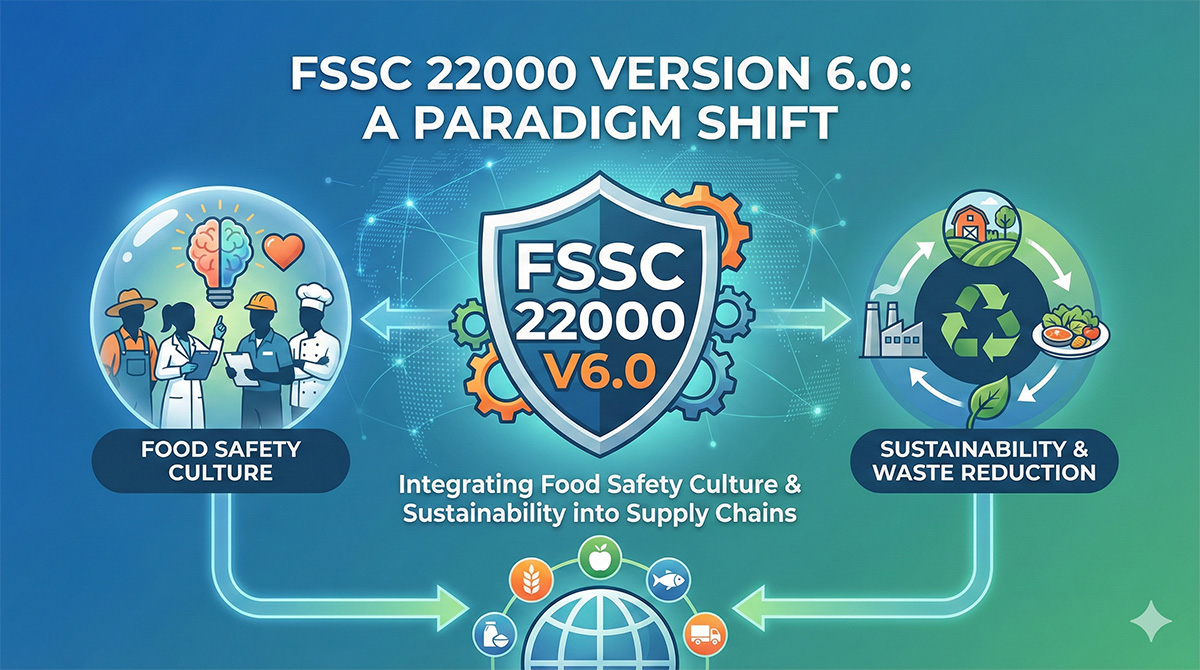
THE NETHERLANDS (April 2023) – The Foundation FSSC has officially published Version 6.0 of the FSSC 22000 food safety certification scheme, initiating a significant transformation in how the global food industry manages safety, quality, and organizational behavior. This major revision goes beyond routine technical updates, firmly embedding "Food Safety and Quality Culture" and sustainability goals into audited requirements for the first time.
The release of V6.0 represents a strategic response to the evolving landscape of global food production. It aligns the scheme with the latest Global Food Safety Initiative (GFSI) benchmarking requirements, incorporates the newly published ISO 22003-1:2022 standard for certification bodies, and addresses growing market demands for corporate social responsibility alongside robust safety protocols. For the more than 30,000 organizations worldwide currently certified under FSSC 22000, V6.0 is not merely an upgrade; it is a call to modernize their entire management philosophy.
The Evolution of the Scheme Structure
FSSC 22000 has long been respected for its robust "three-pillar" structure, which remains fundamental in Version 6.0. The scheme continues to combine the management system approach of the ISO 22000:2018 standard with sector-specific Pre-requisite Programs (PRPs) (such as ISO/TS 22002-1 for food manufacturing or ISO/TS 22002-4 for packaging).
However, the critical evolution in V6.0 lies in the third pillar: the FSSC 22000 Additional Requirements. Found predominantly in Part 2 of the new scheme document, these requirements have been significantly expanded and deepened to plug gaps in existing international standards and address emerging global risks. It is within these additional requirements that the Foundation FSSC has introduced its most transformative changes.
The Cultural Imperative: Making Behavior Auditable
Perhaps the most profound change in Version 6.0 is the elevation of "Food Safety and Quality Culture" from a desirable trait to a mandatory, auditable requirement under Clause 2.5.8.
For years, the industry has recognized that many food safety incidents occur not because of a lack of procedures, but because of a failure in adherence—a cultural issue. Previous versions encouraged a positive culture, but V6.0 requires organizations to provide tangible evidence of it.
The new standard dictates that senior management must establish, implement, and maintain a food safety and quality culture focused on continually changing behaviors. This moves the audit beyond reviewing paperwork and into assessing the organizational mindset. Auditors will now be looking for evidence across several critical pillars defined in the scheme:
-
Communication: How effectively are food safety expectations conveyed across all levels of the organization? Is it top-down only, or is there an open channel for frontline workers to report concerns without fear of reprisal?
-
Training: Moving beyond mere attendance records, organizations must demonstrate that training actually results in competence and understanding of why specific protocols matter.
-
Employee Feedback and Engagement: The extent to which staff are actively involved in food safety improvement initiatives.
-
Performance Measurement: Organizations must define specific objectives and timelines related to cultural improvement and measure their progress.
This shift requires a significant pivot for many organizations. It demands that leadership move beyond signing a policy statement to actively cultivating an environment where doing the right thing is the default behavior, even when no one is watching.
Sustainability Enters the Audit Scope: Food Loss and Waste
In a pioneering move that acknowledges the inextricable link between food systems and global sustainability challenges, FSSC 22000 V6.0 introduces a new requirement addressing Food Loss and Waste (Clause 2.5.16).
This addition directly supports the UN Sustainable Development Goal (SDG) 12.3, which aims to halve per capita global food waste by 2030. Under V6.0, certified organizations can no longer ignore the efficiency of their production processes in relation to waste.
The clause requires organizations to have a documented policy and objectives detailing their strategy to reduce food loss and waste within their organization and the related supply chain. Crucially, it mandates that controls be put in place to manage products intended for donation to non-profit organizations or disposal. This ensures that while waste reduction is encouraged, it never compromises food safety; products diverted from the main supply chain must still be safe for their intended new use or disposed of securely.
This requirement forces food manufacturers to integrate sustainability metrics into their core operational management systems, bridging the gap between corporate social responsibility (CSR) departments and shop-floor quality assurance.
Raising the Bar on Operational Prerequisites
Beyond culture and sustainability, V6.0 includes rigorous technical updates aimed at tightening operational controls and closing known loopholes in hygienic management.
Hygienic Design and Equipment Management (New Clause 2.5.15): A significant addition is the focus on hygienic design. The scheme now mandates that organizations have a documented purchase specification in place that addresses hygienic design, applicable legal capabilities, and intended use for all new equipment or major changes to existing equipment. This is a proactive measure to prevent food safety hazards being "engineered in" through poor machinery design that creates harborage sites for pathogens like Listeria. Furthermore, organizations must conduct a risk-based change management process for existing equipment to assess hygienic design risks.
Strengthened Allergen Management (Clause 2.5.6): Allergen recalls remain a dominant issue globally. V6.0 strengthens requirements for allergen management plans. It explicitly requires a list of all allergens handled on site, including those in raw materials and processing aids. Crucially, it adds more rigorous requirements for validation and verification of cleaning procedures to prevent cross-contamination. It also mandates stricter controls over product labeling to ensure the correct allergen information reaches the consumer, addressing a common cause of recalls.
Risk-Based Environmental Monitoring (Clause 2.5.7): The requirements for environmental monitoring have been refined to emphasize a risk-based approach. Organizations must have a documented program to monitor contaminants and pathogens in the production environment. V6.0 specifies that this program must be reviewed for effectiveness at least annually, or immediately if significant changes occur in the facility (such as new machinery installation or construction), rather than just waiting for a positive pathogen result to trigger a review.
The Distinct Role of Quality Control
While FSSC 22000 is primarily a food safety standard, V6.0 provides clearer delineation and emphasis on Quality Control (Clause 2.5.9).
The revised clause requires organizations to establish, implement, and maintain quality policy and objectives. It mandates the evaluation and analysis of food quality parameters based on customer specifications and legal requirements. This includes stricter oversight of quantity control (e.g., weight and volume checks) and line start-up and change-over procedures. This ensures that certified companies are delivering products that are not only safe to eat but also meet the quality expectations defined in their contracts and labelling regulations.
Impacts on the Audit Process and Certification Bodies
Part 3 of the V6.0 document, which outlines requirements for Certification Bodies (CBs), contains changes that will directly impact how audited organizations experience the certification process.
By aligning with ISO 22003-1:2022, the methodology for calculating audit duration has been revised. For many organizations, particularly those with complex processes or high-risk products, this could lead to longer on-site audits to allow auditors sufficient time to evaluate the new, more nuanced requirements like food safety culture.
Furthermore, the rules regarding Unannounced Audits have been solidified. The scheme requires that at least one of the two surveillance audits in a three-year certification cycle must be unannounced. This serves as a critical mechanism to ensure that food safety standards are maintained every day, not just during the weeks leading up to a scheduled inspection. The implicit message of V6.0 is that an organization must be "audit-ready" 365 days a year.
The Transition Timeline: A Call to Action
The publication of Version 6.0 in April 2023 started the clock on a crucial transition period for the global food industry.
The Foundation FSSC has established a 12-month window for preparation. Audits against the new FSSC 22000 V6.0 requirements will become mandatory starting April 1, 2024. All organizations currently certified under Version 5.1 must complete their upgrade audits within the calendar year 2024 to maintain continuous certification.
This timeline presents a significant challenge. Organizations need to conduct comprehensive gap analyses to identify areas where their current systems fall short of the new V6.0 requirements—particularly in less tangible areas like cultural maturity and sustainability tracking. Developing the necessary policies, training staff, changing operational behaviors, and generating the required historical evidence for auditors will require substantial time and resources over the coming year.
Conclusion: Maturity and Resilience in the Food Chain
FSSC 22000 Version 6.0 is more than a technical standard update; it is a reflection of a maturing global understanding of food safety. It acknowledges that in a complex, interconnected world, technical barriers and HACCP plans alone are insufficient. By integrating behavioral science through food safety culture, admitting ecological responsibilities through waste reduction, and tightening engineering controls through hygienic design, V6.0 aims to build more resilient food supply chains.
For global food manufacturers, the message is clear: future-proofing a business requires a holistic approach where safety, quality, culture, and sustainability are integrated into a single, robust management system. The journey to V6.0 compliance begins now.
Dowload File: FSSC 22000 Version 6.0